
Watch and Shoot
A return after a pause — and a look at Iran, Canada’s defence strategy, and a changing North American relationship.

As happens every so often with me, I felt in need of a break from Substack. If you’re new to the Black Cloud, you’ll quickly notice that this happens fairly often. After all, I write articles primarily for my own intellectual engagement and as a way to remain engaged during my forced retirement. This means I don’t feel the need to comment on every issue, especially those that I don’t feel qualified to comment on. Add to this some family-related events and travel (I have a teenage daughter) and the gap between articles grows occasionally. That’s simply how this space works. If you’ve subscribed thinking that I publish on a schedule, my sincere apologies.
That being said, there have been some seismic events since my last piece. Internationally, Trump has continued with his threats against Canada, there have been a number of developments on the Canadian military front, and the international situation remains grave. With this in mind, I thought it might be useful to provide a bit of synopsis by way of commenting, with a view to expanding upon some issues in the future.
Trump and Iran
At the time of writing, the Winter Olympics have ended, and Donald Trump is continuing his military build-up in the Middle East, aimed at Iran. Frankly, despite weeks of signaling, Trump’s objectives and strategy remain, as usual, unclear. The build-up is massive, consisting of two carrier strike groups, a large number of Tomahawk missile-equipped vessels, and land-based combat aircraft at a number of locations near Iran, including Al-Udeid in Qatar. Trump promised the Iranian opposition that “help is coming” weeks ago, during the widespread anti-regime protests, but the moment appears to have passed — at least for now.
As we saw in Venezuela, we could be entering a period of prolonged waiting, with forces at very high readiness, while Trump makes up his mind. Based on past behaviour, we can reasonably expect two things: Trump will likely select the lowest-risk option available, and it will consist primarily of airstrikes. What purpose this will serve is, well, beyond me. Airstrikes alone are unlikely to force regime change and, unless targeting is extremely careful, risk alienating those Trump claims to be assisting. If the target is the Iranian nuclear program, was that not “eliminated” by Trump’s attacks last year (it wasn’t)?
Trump supporters are already mystified that Iran hasn’t “capitulated,” reasoning that the mere presence of overwhelming US force should be sufficient to bend Tehran to Washington’s will. As usual, this is wishful thinking. The mullahs’ regime is completely invested in retaining power and would be more likely to burn it all to the ground rather than render tribute to Trump. After all, they have no issues with slaughtering thousands of Iranian citizens; what would make a futile war with the US any different? Moreover, and this is important, Trump hasn’t exactly articulated what the conditions for an Iranian capitulation would look like.
As it is, an American attack on Iran, perhaps in conjunction with Israel, would likely be viewed by many as a violation of international law, no matter how odious the Iranian regime is. Airstrikes would be yet another example of what appears to be the real “Trump doctrine” — that the world is to be run by the most powerful and that the United States gets to dictate policy and act in its own self-interest. Current trends suggest escalation remains likely. There is little evidence of consideration for second- or third-order consequences. So, let the aircraft and TLAMs fly, consequences be damned; Trump will be on to the next thing in a month or so.
Canada’s Defence Industrial Strategy
Last week, the Canadian government announced a new defence industrial strategy aimed at increasing sovereign Canadian defence production capacity and the amount of Canadian equipment procured by the Armed Forces. I won’t have too much to say on this for now. It is too early to tell what the strategy will actually translate into and reality has a tendency to intrude. That being said, the objectives are laudable and probably achievable. I would introduce two major notes of caution at this stage.
There is a horrible tendency for governments of all stripes to sacrifice operational capability for regional economic gain. Repeatedly, the Armed Forces have had to settle for sub-par equipment simply because it could be built in this or that MP’s riding. Anyone who has watched Canadian procurement for more than a few years will recognize the pattern. While I agree that economic considerations are important, this type of behaviour cannot continue if we are to rebuild the military.
Secondly, Canada has a horrible track record in attempting to develop and field equipment independently. Examples abound of extended development periods, massive cost overruns, political interference, reliance on mythical “overseas markets” to bankroll projects, and the like. It is much better if we crawl before we try to walk. That means concentrating on proven Canadian-built capabilities and, just as importantly, seeking foreign partners with whom we can either share licence-built equipment or development risks. If we plunge headlong into developing major military equipment independently, the risks to the Armed Forces’ operational readiness and to the taxpayers’ wallets are huge.
Army Restructure
As some readers may know, the Army is at the beginning of a major restructuring plan designed to improve operational readiness and, eventually, to give Canada a fully deployable division capable of major combat operations. This is the initiative of Lieutenant-General Mike Wright, the Army Commander — a pretty smart cookie with a reputation for pragmatic thinking. Moreover, this time the plan is backed by major equipment initiatives that are actually programmed and funded — for the first time since I became affiliated with the Army many years ago.
There are issues, though, and I plan to address these in a forthcoming article. This has proven somewhat difficult to write, especially as I attempt to translate technical jargon into something more relatable. Watch and shoot, as we used to say.
Trump Sails into Greenland
Finally, Trump is up to his usual antics. MAGA has reacted to the US men’s hockey team winning Olympic gold with more distasteful (and incredibly juvenile) attacks on Canada. “Loser Canada Loses” read a Fox News chyron after the women’s hockey final loss, and Trump has posted AI video of himself as a hockey player assaulting a Canadian. The US team itself hasn’t been much better, and I mention this only because it reflects a bigger issue: the rift between Canada and the United States will take a generation to repair, no matter how much Maple MAGA and some business leaders try to wish it away. I may not be a “typical Canadian,” but my respect for and confidence in the US is absolutely gone.
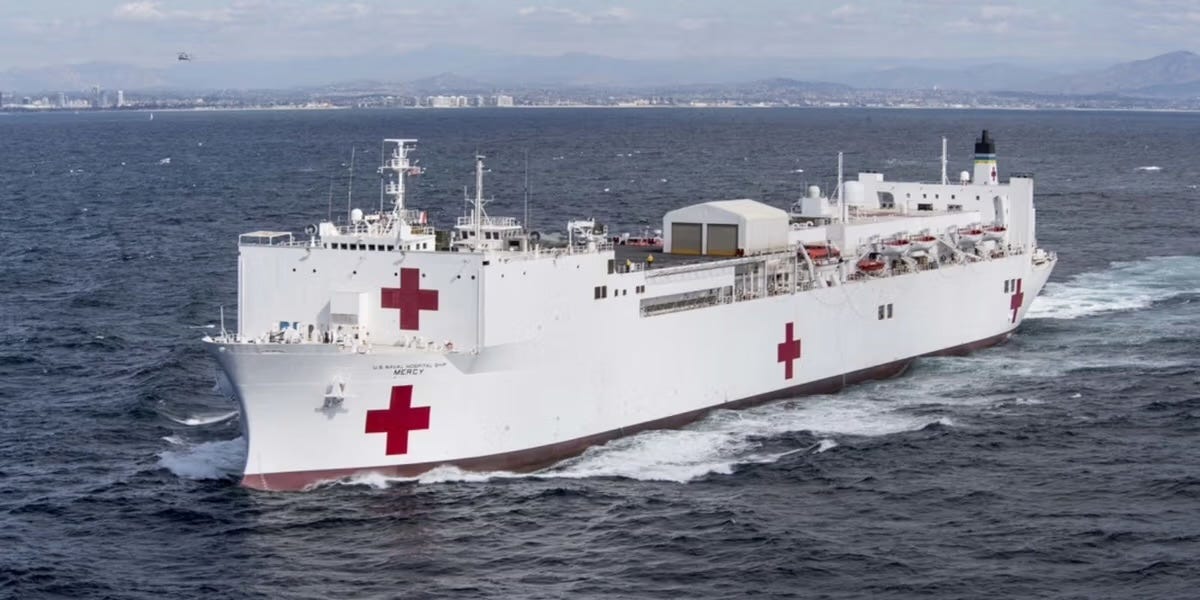
The best illustration of the new American attitude occurred in a farcical episode earlier this week. Trump announced on his pet social media platform that a US Navy hospital ship was to sail to Greenland to administer aid to infirm and ill Greenlanders — as soon as possible. Never mind that Greenland has universal healthcare or that the Americans would arrive entirely uninvited; what Trump says — no matter how bizarre — is expected to be translated into action. Unfortunately for the President, both Navy hospital ships are laid up in extended repairs and cannot deploy.
Taken together, these developments suggest we are entering a period in which Canadian strategic assumptions will be tested more severely than at any point in recent memory. That is where I intend to focus next.
Watch and shoot.
Also, on the hospital front, Denmark recovered a stricken US sailor from a submarine and transported him to Greenland for treatment.
It is so good to have the voice of reason back to comment, based on knowledge and experience