
So Much for the Sabbatical
Canada chooses submarines, buys long-range missiles, expands its NATO role, and generally ruins my summer break.

Okay, fine…
Only two weeks ago, I published a brief piece announcing a sabbatical, in part because things were quiet and I was tired of the same old, same old from Donald Trump.
Unfortunately for me, just after pressing “send”, Canada decided to make some of the most consequential defence-related announcements of my adult lifetime.
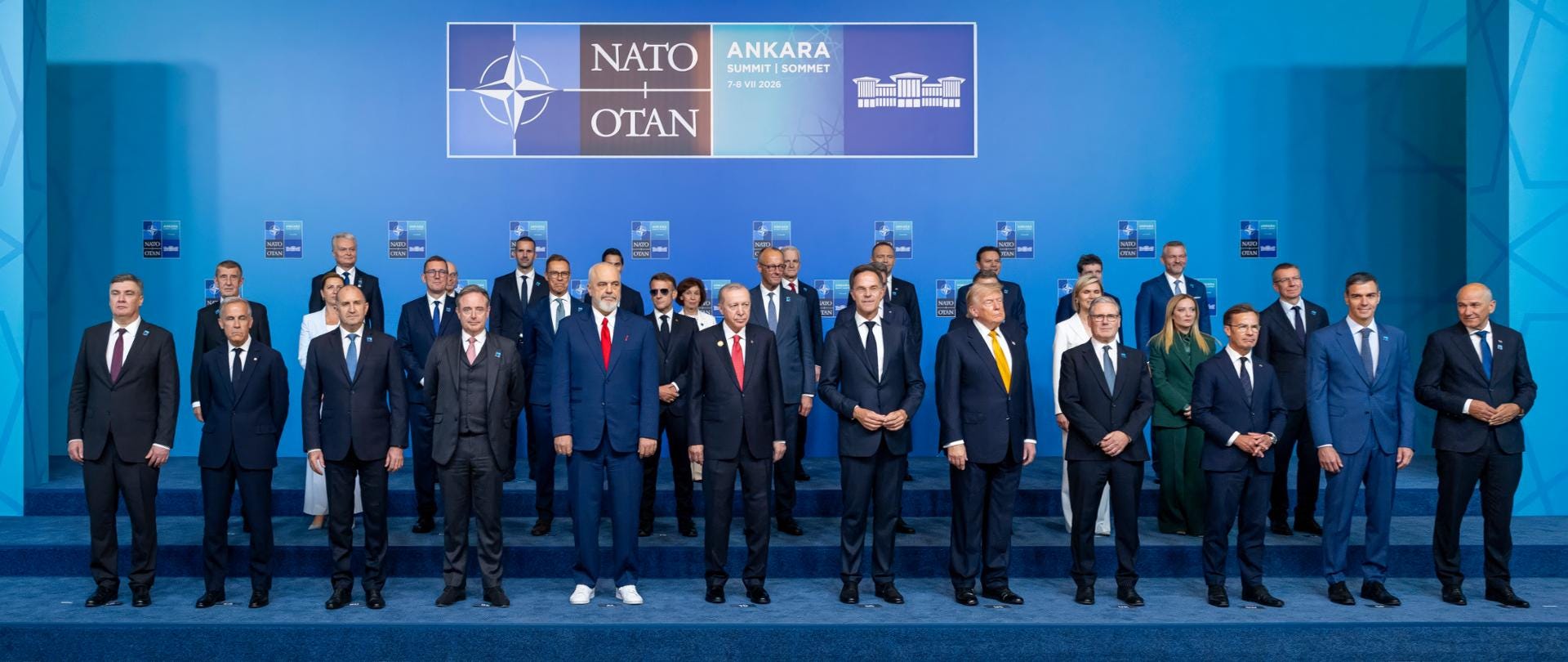
The most significant of these was, of course, the selection of Germany’s TKMS as the preferred supplier to provide Canada with “up to” 12 conventionally powered submarines. There were others, though, made on the margins of the Ankara NATO summit, that were almost as consequential. I’ll try to offer some comment on each, bearing in mind that I am often limited in my technical knowledge; most of the major equipment announcements fall well outside my professional experience in land operations.
The Selection of the German-Norwegian Type 212CD Submarine
The selection of the German-Norwegian bid over that of South Korea shouldn’t really have come as a surprise, no matter how attractive the Korean bid appeared to be — and it appeared to be extremely attractive, based upon a very capable platform.
However, the lure of purchasing a similarly capable submarine from two NATO countries, one of which Canada is pursuing extensive cooperation with in the Arctic, was always likely to be too strong. Operating the same platform as Germany and Norway offers obvious advantages in training, maintenance, logistics, spare parts, weapons, technical development and, potentially, personnel exchanges. It also opens the door to much closer cooperation in operations and sustainment over the lifetime of the fleet.
TKMS has been selected as the preferred supplier rather than being awarded a final contract. Negotiations will now take place over price, configuration, industrial benefits and the many other details involved in a programme of this size. If those negotiations fail, the South Korean bid remains available as a fallback.
Where doubt creeps in is Canada’s desire to procure “up to 12” boats. This is a very serious undertaking and would place Canada near the forefront of conventional submarine operators globally. Frankly, the sustainment, infrastructure, personnel and other challenges are likely to mean that the full number may never see the light of day.
Moreover, as usual, the procurement timelines are very long. The first four submarines are expected to begin arriving in 2034, even with Germany and Norway offering to reallocate production slots to accelerate Canadian deliveries.
That being said, this procurement will give Canada a powerful capability, designed for Arctic patrol and possessing exceptionally low acoustic and magnetic signatures. It will also allow close joint operations with two NATO countries — one of them another Nordic nation — that operate the same platform.
It is the clearest sign yet that the pivot to Europe is real.
Joint Strike Missiles
Lost in the submarine noise were a number of other announcements. One of the most important was the decision to procure Joint Strike Missiles from Norway.
The JSM is a long-range precision-strike missile capable of hitting targets more than 150 kilometres away. Canada has never possessed such an air-launched capability, and one can easily see how much of a deterrent it might provide against Arctic incursions or in defence of NATO’s Eastern Flank.
The Royal Canadian Navy’s new River-class destroyers are already intended to carry the related Naval Strike Missile. The NSM and JSM are not identical weapons, but they belong to the same Kongsberg missile family, potentially offering some advantages in training, industrial support and logistics.
Combined with the Army’s planned procurement of HIMARS rocket systems, Canada is suddenly moving towards possessing a credible long-range precision-strike capability of a kind found in relatively few nations.
A submarine-launched derivative of the missile family has also been discussed for the Type 212CD programme, although this remains a prospective rather than confirmed Canadian capability.
Flying under the radar — pun intended — is the fact that the JSM’s current operational integration path runs through the F-35 fighter aircraft. It was designed from the outset to fit inside the F-35’s internal weapons bays. I have found no evidence of an active programme to integrate it with the Swedish Gripen.
An approximately $800-million Canadian purchase of the missile is therefore a very strong signal that Canada will proceed with at least a major portion of the planned F-35 purchase. Of course, this doesn’t rule out the eventual acquisition of a mixed fleet, but we will certainly be flying the F-35.
As an aside, I am beginning to get twitchy about the F-35’s radar.
Canada is currently expected to receive the mature and fully functional APG-81 radar rather than the much newer APG-85. The latter has suffered from production, certification and integration problems, while the additional electrical power and cooling required by the Block 4 upgrade remain significant technical challenges.
Several US Marine Corps F-35Bs have even been accepted without radars installed. These aircraft can be used for basic flying but are unable to conduct combat missions or meaningful combat training.
More troublingly, the APG-85 has not yet been cleared for export, even to F-35 partner nations. Canada is therefore not currently slated to receive it.
This raises an important question: is this merely a temporary result of the APG-85’s troubled development, or is the programme evolving into separate American and export configurations?
Given Canada’s financial and industrial participation in what was presented as a common, continuously evolving fleet, Ottawa should be demanding a clear answer. I think it entirely possible that the Trump administration will permanently restrict export of the APG-85 once its technical problems have been resolved.
We shall see.
Arctic Communications
Another important announcement was the agreement in principle with Telesat to use its Lightspeed satellite constellation for the military Ka-band portion of the Enhanced Satellite Communications Project — Polar.
The critical feature of this procurement is that it will provide a sovereign, Canadian-controlled communications capability throughout the Arctic rather than one dependent upon American infrastructure or permission.
Obviously, this is another capability that will be very useful for NORAD — and, increasingly, NATO — tasks, but it will remain under Canadian control.
That distinction is becoming increasingly important.
NATO Force Posture
Canada has also announced that it will become the third Framework Nation for Multinational Division North, alongside Denmark and Latvia, taking on a larger role on NATO’s Eastern Flank.
This complements Canada’s leadership of the multinational brigade in Latvia and suggests a very concrete commitment to NATO and to a persistent, if not effectively permanent, Canadian presence in the Baltic region.
Canada has also extended Operation REASSURANCE until 2031 and plans to increase the number of persistently deployed personnel to as many as 2,600.
Much of this is, of course, political. It gives Canada a way to demonstrate — in real terms — a commitment to both the Alliance and Europe.
It remains to be seen whether the Canadian Armed Forces, and particularly the Army upon which much of the force-generation burden will fall, can sustain such commitments over the medium to longer term.
The Army is already understrength, overtasked and struggling to generate personnel for its existing commitments. Announcing a persistent presence is one thing. Generating, training, equipping and rotating the forces required to maintain it year after year is quite another.
The Elastic 5%
Much has been made of NATO’s new target of spending 5% of GDP on defence and defence-related requirements, adopted at The Hague last year and reaffirmed at Ankara.
NATO leaders have been careful to “credit” Donald Trump for this Alliance-wide measure, something that can be read in two ways: either Trump was so effective in persuading the Allies to improve their defence postures that they all immediately agreed, or he has made the United States so unreliable and hostile to its traditional allies that dramatic increases became almost mandatory.
I’ll leave it to the reader to decide.
Whatever the truth, Canada was quick to announce that it was “on track” to meet the 5% target.
As with many things, however, all is not quite as it may appear to the uninitiated.
The actual core defence-spending target is 3.5% of GDP. The remaining 1.5% may be made up of investments in strategic infrastructure and broader national resilience, including ports, transportation networks, communications systems and critical-mineral development.
Canada has also shuffled the accounting deck to improve the immediate picture, including the Canadian Coast Guard and spending by other departments in its NATO figures. Veterans Affairs alone accounts for approximately $7.8 billion and is now the second-largest departmental contributor to Canada’s reported defence spending.
Admittedly, many other NATO countries do the same, and none of this necessarily violates NATO’s accounting rules. However, a figure in which Veterans Affairs is the second-largest departmental contributor tells us considerably less about present combat capability than the headline percentage might imply.
The inclusions allowed Canada’s reported defence spending to take a sudden leap. It’s not exactly smoke and mirrors, but it certainly allowed the Government to announce dramatic increases sooner rather than later.
On the positive side, the changes to Canada’s defence posture have been sweeping and real. It appears to me that the Government is genuinely serious about reaching the core 3.5% defence-spending target, although doing so — and turning that spending into usable military capability — will take considerable time.
Trump and the Looming Crisis
Casting a dark shadow over NATO is, of course, Donald Trump.
The Wall Street Journal reported that Trump was conciliatory and genial during private meetings in Ankara. I think one must take this with a grain of salt.
Whatever goodwill Trump may have generated in private was promptly overshadowed in public by his renewed demand for Greenland, his direction to staff to “cut off all trade” with a “wasted cause” Spain, and the resumption of his bizarre and increasingly irrational diatribes towards Iran.
The latter, of course, still occupies much of Trump’s attention as we lurch from “ceasefire” to open warfare and repeated threats from both sides over the Strait of Hormuz.
There is no obvious end in sight. Trump will never willingly back down, while Iran has little incentive to do so. Indeed, it remains difficult to determine what political or military end state the United States is attempting to achieve.
Somewhat troubling is Prime Minister Carney’s occasional rhetorical support for Washington’s stated objectives throughout this fiasco. While it is true that his words mean virtually nothing in practical terms, I’m not sure that encouraging Trump — even while simultaneously calling for a genuine ceasefire — does much good.
Conclusion
Overall, things seem to be moving remarkably quickly on the defence and strategic fronts.
While I applaud these large and potentially game-changing announcements, I remain leery of the pace, the delivery timelines, and our ability to generate and sustain enough personnel for both the new equipment and the new commitments.
Moreover, it seems to me that we still have critical capability gaps across the Canadian Armed Forces that need to be addressed sooner rather than later. Long-range missiles and advanced submarines are extremely welcome, but they do not solve shortages of personnel, ammunition, air defence, vehicles, infrastructure and countless other less glamorous requirements.
I know work is being done on these fronts, so there is reason to be optimistic.
I just wish they’d hurry up.
I will be in Europe and the United Kingdom for the next few weeks, and the atmosphere there should be interesting. I will, of course, report on anything important.
Until then, I hope everyone is having a great summer.
Being a veteran myself I am quite happy with the new attention our military is receiving, it was long overdue. You didn't mention the raise our service women and men received which also added to our target. I have also been concerned with coverage for Latvia for the long term, I would like to see recruiting numbers climb faster, but they are increasing. My nephew recently enlisted and is currently in basic training, then it will be off to battle school for him.
I can't recall a time when we ever had 12 subs, that's a lot of bodies that the RCN currently does not have, so even though it hasn't been announced yet, I am expecting an increase in regular service personnel because 12 subs will require crews we currently don't have.
While the Canadian people for the most part are currently onboard with increased military spending, the time will come when their attention changes, it's one thing to say we are on track to hit 5% GDP investment, it's another to say we can sustain that year after year without Canadians getting fed up. I worry as attention shifts and people want more investment in other things, the first place to receive cuts will be the military or VAC. It remains to be seen but our history shows our military is often an after thought for Canadian voters. Only time will tell.
Lastly, all these new toys and it makes me wish I was young enough to serve again! It is an exciting time for our troops, as we all get excited over new toys. I was in Gagetown when we retired the Twin Huey and Kiowa and welcomed the CH146 Griffin, the build up period was a lot of fun, with people gaining new skills on a new air craft. I am quite certain people on the Aurora, or the F18 are looking forward to their replacements. New toys often bring in more recruits as well, let's hope this is true this time!
Bang on comments!! Best short summary I have seen on all of these “happenings” so far.
Well done you!!