
Canada Doesn’t Need Warriors—It Needs Soldiers
Why Soldiering Demands Ethics, Discipline, and Canadian Values

I’d never heard of Andrew Tate until my daughter came home from school (she was in Grade 8) and mentioned that “all” the boys in her class were talking about this guy online and saying how awesome he was. My daughter was horrified and had me check him out. I was soon horrified too, for what I found was a puffed-up buffoon. A rabid misogynist. A criminal. Someone utterly toxic. Yet legions of 13-year-old boys were looking up to him and hanging on his every word.
I’ll admit to being completely baffled. Here was someone transparently stupid, spouting utter nonsense in the guise of providing advice to men. I soon found that there was a plethora of these toxic influencers, all saying the same thing: kindness and empathy are weakness, education is worthless, women are to be used, and the rules don’t apply to them. Everything is a transaction and the pursuit of wealth is the entire focus; altruism is pointless.
It should be no surprise, then, that this philosophy is reflected in the modern-day US Republican Party and the Trumpist MAGA movement. Toxic manosphere influencers and MAGA are interconnected at multiple levels: Tate, Joe Rogan, and all the rest are vocal supporters of Trump. There are spillover effects into “manly” sports like MMA fighting. Trump has even announced that, in a stunning display of crassness, an MMA fight will be held on the White House grounds, while major leagues donate lavishly to MAGA causes.
In my opinion, toxic influencers, MMA (and other “masculine” pursuits), MAGA, and the far right are all intertwined. Their audience is characterised by the demeaning of empathy, disdain for education and expertise, a sense of elitism, and a philosophy best described as “fuck you, make me.” This attitude extends from the White House to Canadian “convoy” and Trump supporters. It also extends, in a different form, to the Armed Forces and to debate surrounding defence issues.
Such men—and it is men—consider themselves to be mentally and physically tough and believe that empathy and concern for others is a weakness. In a military context, this is often translated into what many have called a “warrior culture.” This is the idea that mental and physical hardness is the only means to achieve success. It relies fundamentally on mythology about warrior societies and on the idea that warriors are a breed apart from society and that only certain, special men are to be admitted to their ranks. Empathy, education, and thoughtfulness are symptoms of weakness or worse. Never mind that guys like Andrew Tate wouldn’t survive long in many of the Army’s training exercises, let alone on operations. It’s the myth that counts.
So of course MAGA has grabbed on to this concept with both hands, demanding an end to so-called “woke” policies and a “return” to warrior culture as the only way to win wars. This was echoed by the Canadian Conservative Party during the last election, although this more reflected the abysmal state of defence literacy in Canada than anything else.
In the US, Trump put this idea into action by selecting a self-proclaimed “warrior,” the stupendously unqualified Pete Hegseth, as Secretary of Defence. Hegseth has accomplished very little of substance aside from leading physical fitness training to demonstrate his warrior credentials. His entire career has been mediocre and measured by a massively inflated résumé and ego.
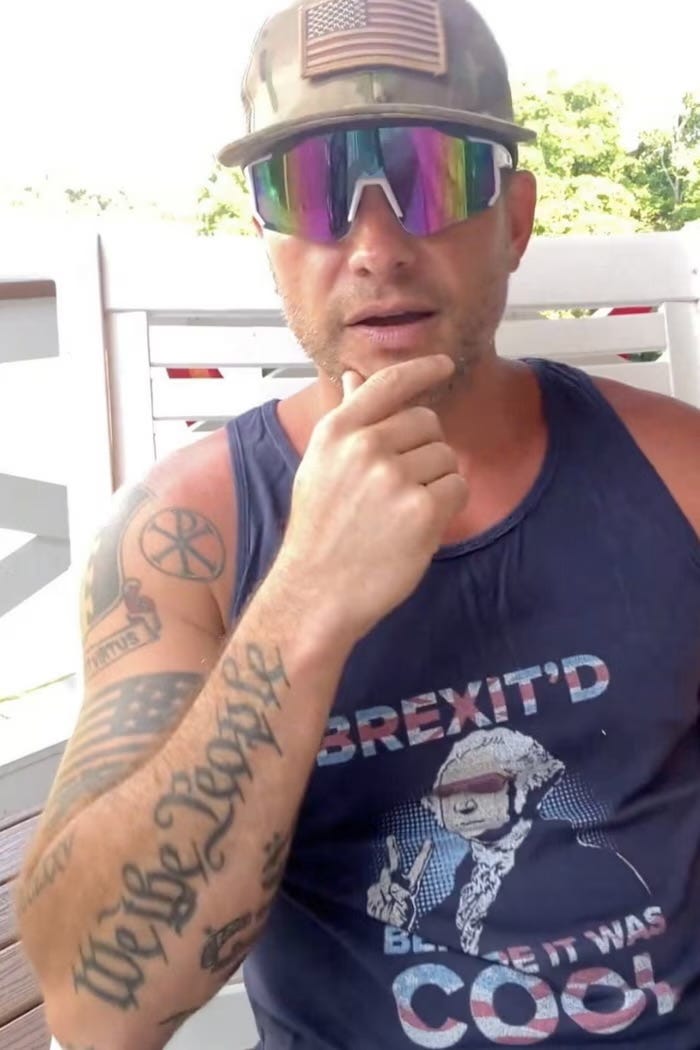
The “warrior” concept is almost entirely American and has been one of their more distasteful military exports. Prior to Canada’s involvement in Afghanistan, where we worked incredibly closely with the US, warrior culture wasn’t much of a thing. To be certain, elements could be found, especially in infantry units. Indeed, an early form of warrior thinking, with hazing, false elitism, and an ethos that denigrated empathy and critical thinking led directly to the disbandment of the Canadian Airborne Regiment in the 1990s.
Having said this, there is a tiny grain of truth in what warrior culture espouses. There is a place for fitness, team cohesion, and quick and decisive discipline, something that Ottawa has forgotten amidst a barrage of Human Rights decisions and external reviews. The military, by definition, has a distinct and separate culture, one that must limit the rights enjoyed by the rest of the country to be operationally effective.
This doesn’t mean buying into the warrior propaganda, and the CAF has had major issues absorbing the grains of truth I mention within its wider culture. This has left it open to accusations of softness and operational ineffectiveness, none of which have been proven in practice. Worse, these issues led the Conservatives to parrot MAGA propaganda about warrior culture, despite being totally unable to define what it means.
So, while I wasn’t a warrior, I was a soldier and there is a major difference. Issues like the Airborne aside, Canadians in uniform have long described themselves as soldiers rather than warriors. What’s the difference? Well, I’ve prepared a little chart to illustrate what I mean.
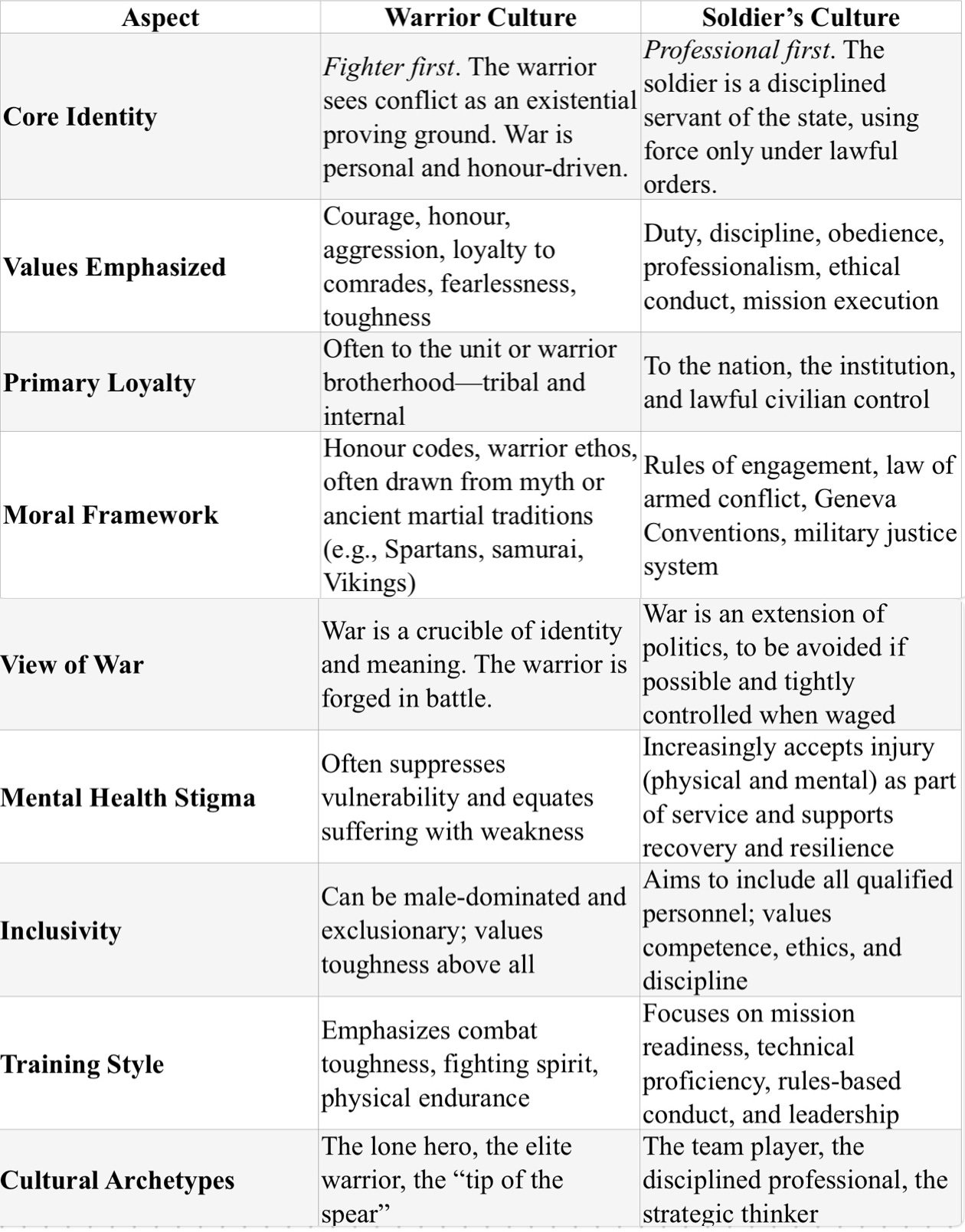
Unfortunately, this entire issue has, as I mention above, become politicized, given fuel by MAGA “warrior” propaganda from the United States, by an obvious emphasis on cultural issues by the Trudeau government, by an opposition looking to score political points, and by a tiny minority of far-right CAF veterans looking to stoke division and controversy. I wrote about the latter describing their views in my very early piece “We’re Better Than You.”
The right-wing critics and trolls pollute social media, criticizing the CAF as being unable to fight, as being hijacked by “wokeness,” and led by incompetent officers chosen for their woke credentials rather than operational competency. Groups like “Veterans For Freedom Canada,” Diagolon, and others deliberately target serving members, using their credentials as veterans to poison the discourse in Canada and to push disinformation. They litter the CAF’s social media with abuse and accusations, usually without foundation.
The result is a perfect storm. The entire US Government is engaged in a war against “wokeness” and the American military is in the process of reversing many social directives in a misguided effort to “restore” a warrior culture—a culture that never really existed except in the minds of right-wing commentators like Hegseth. The spillover effect on Canada is enormous, and the Canadian right has adopted MAGA views on defence almost without question.
Young men—and it is men we’re discussing—still form the bulk of the potential recruiting base for the Canadian Armed Forces. This is precisely the group that is under constant bombardment by people like Andrew Tate, MAGA (and Maple MAGA) politicians, and by far-right groups like Veterans for Freedom Canada. The situation becomes worse when the small positive aspects of warrior culture come under scrutiny from a government that appeared to care little about the basis of military culture in general. This leads to situations where some CAF members may find themselves in sympathy with Trumpism and the anti-wokeness crowd and may become radicalised. Others may have joined the military with preconceived notions, created by American media, of what serving actually looks like.
The result are discipline problems like the ones we saw in Ottawa and, in a more serious situation, in Quebec earlier this month. Unfortunately, addressing these issues is not as simple as some in the media or academia would have us believe.
First, it is almost impossible for the recruiting system to tell who has “anti-woke” or even more radical views during the recruitment process. The entire process depends on the truthfulness of the recruit, and one can easily lie. There would be privacy issues with the examination of a recruit’s social media without cause. Thus, if one keeps quiet, it is possible for virtually anyone to make it through the process—barring any physical or psychological issues.
Once someone has made it through basic training, the issues continue. Part-time soldiers (i.e., Reservists) are not on duty unless actually at work and are not subject to military discipline. Military supervisors see their soldiers perhaps three hours a week and one weekend a month. It is extremely difficult to police a Reserve soldier’s behaviour within these limitations. These issues continue, albeit in a different form, when dealing with full-time (i.e., Regular Force) soldiers.
In the Regular Force (indeed across the CAF in general), Charter issues have repeatedly come into conflict with traditional military discipline. Supervisors are extremely unlikely to examine a soldier’s social media without direct cause and, perhaps, without the assistance of the military police. Fear of a litany of redresses, legal action, and an increasingly civilianized disciplinary system also can lead to inaction. The CAF has accepted, virtually without question, a variety of Human Rights Commission directives in this arena, despite the Supreme Court repeatedly acknowledging the uniqueness of military service.
Thus we have a dichotomy: individual rights versus traditional discipline when the entire system is becoming less, not more disciplined. No amount of awareness training or cultural sensitivity classes will eliminate those who espouse far-right views or who still engage in MAGA-inspired online shenanigans. Without action, these people could be left to rot the entire military from within.
I believe we need to acknowledge the validity of some of what “warrior” culture says and restore a focus on operational readiness, fitness, and discipline. There is something to be said for having a force that is absolutely ready to fight at any time. I believe that Canadians expect this. Moreover, it doesn’t hurt to have a force that presents itself well in public and inspires confidence. Finally, having experienced it, there is some truth to the “warriors’” focus on bonding within small units and on the relationship between soldiers.
But that’s as far as it goes. The rest is mythological tripe that is anathema to operational effectiveness and is based largely on movies and television. It is the type of thing professionals view with suspicion.
So what to do? First, ensure that expectations are set right at the door of the recruiting office. By this, I don’t mean the same old focus on ethos and cultural sensitivity. I mean a focus on the ethics of soldiering as I describe above—right from the beginning. Secondly, supervisors need to be empowered to administer discipline. People join the military expecting that it is a disciplined environment and that some rights enjoyed by other citizens may not be available to them. We need less civilianization of the system in general and fewer lawyers, not more.
I think we also need to acknowledge that no amount of system-imposed cultural sensitivity training or ethics education is going to convince a true racist or extremist to change their views. This solution, beloved by academics, is preaching to the converted and only adds fuel to the accusations of “wokism” and a focus on cultural wars. We need to address attitudes long before a soldier is sitting in a classroom getting their annual cultural awareness lecture. This means having a leadership with the mandate and authority to stomp out extremism as it’s discovered.
But, as with other things, I feel that something is indeed happening. CAF social media has become much more direct in addressing disinformation and accusations online. There seems to be a renewed focus on operations rather than cultural issues. Things like fitness and preparation are being stressed from basic training forward; recruits are being warned that they need to prepare both mentally and physically. This is all to the good.
Soldiering is an honourable and worthy profession, and Canadians are extremely good at it. It reflects the values of the society it serves with the added awesome responsibility of being the only profession that may deliberately employ violence to attain objectives. Warriors, on the other hand, serve a myth. It is critical that Canadians understand the difference, especially as we begin to disentangle from the United States.
We have our own culture and our own way of soldiering, one that is worth preserving. Canada’s military culture must reflect our own values—not imported myths. It’s time to reclaim the profession of arms from the caricatures of warrior fantasy and reassert the ethics of the soldier.
Personal Notes
I rarely (if ever) write on “cultural” issues but this article is an exception. Don’t expect much more of this sort of thing!
Subscriber chat: I’ve noticed (and been told) that spammers have somehow gotten hold of the chat and are bombarding folks with junk. I may need to shut it down until I can figure out what the issue is.
Scheduling: I’m heading off on holiday until mid-August and certainly won’t be writing. With my daughter away from school, I have not had a lot of time to put articles together. My apologies to subscribers and I’ll be back in force after mid-August. In the meantime, I’ll check in every so often.
Have an amazing summer!
I removed comments from Rian Stone, a known figure in the “manosphere” who pushes toxic “red pill” nonsense—full of misogyny, fake toughness, and a warped idea of dominance that’s the opposite of real leadership and respect. He’s also been banned.
This article calls out this garbage and its bad influence on military culture. Instead of a proper debate, Stone attacked me aggressively. After trying to stay calm, his behaviour crossed the line, so I have deleted his comments and banned him.
This place is for honest, respectful discussion—not for bullying or nonsense like that. Thanks for understanding.
I meant to include this article from a US perspective. It resonates (free gift article):
https://www.theatlantic.com/magazine/archive/2025/08/warrior-myth-lethality-pete-hegseth/683247/?gift=sASPKFE6hWNuUoCz0YtLmVJDDBCbmb8P-iUTDA133jA&utm_source=copy-link&utm_medium=social&utm_campaign=share